
- Stage of development
-
Technology validated at laboratory scale, with cement paste prototypes manufactured and characterised.
- Intellectual property
-
European patent application filed.
- Intended collaboration
-
Licensing and/or co-development
- Contact
-
Ángel IbáñezVice-presidency for Innovation and Transferangel.ibanez@csic.escomercializacion@csic.es
- Reference
-
CSIC/AI/016
Additional information
#Energy
#Carbon capture
Multifunctional material for CO₂ capture and passive building cooling
High-performance mineral additive that enables permanent CO₂ capture and storage under mild conditions, combined with passive building cooling through superior optical properties. Its integration into cements and concretes is compatible with standard industrial processes.
- Market need
-
The construction industry is seeking solutions to reduce its carbon footprint and mitigate urban overheating. Current CO₂ capture systems are expensive, require high temperatures and long processing times, and fail to generate value-added products.
Furthermore, construction materials do not offer effective passive cooling without additional coatings. There is a growing demand for additives that combine both functions and can be easily integrated into existing industrial processes.
- Proposed solution
-
A mineral additive (xonotlite) which, when added to cement or concrete, permanently and stably fixes CO₂ under low temperature and pressure conditions within minutes. In addition, the resulting material reflects solar radiation and emits heat into space, reducing building surface temperatures without energy expenditure.
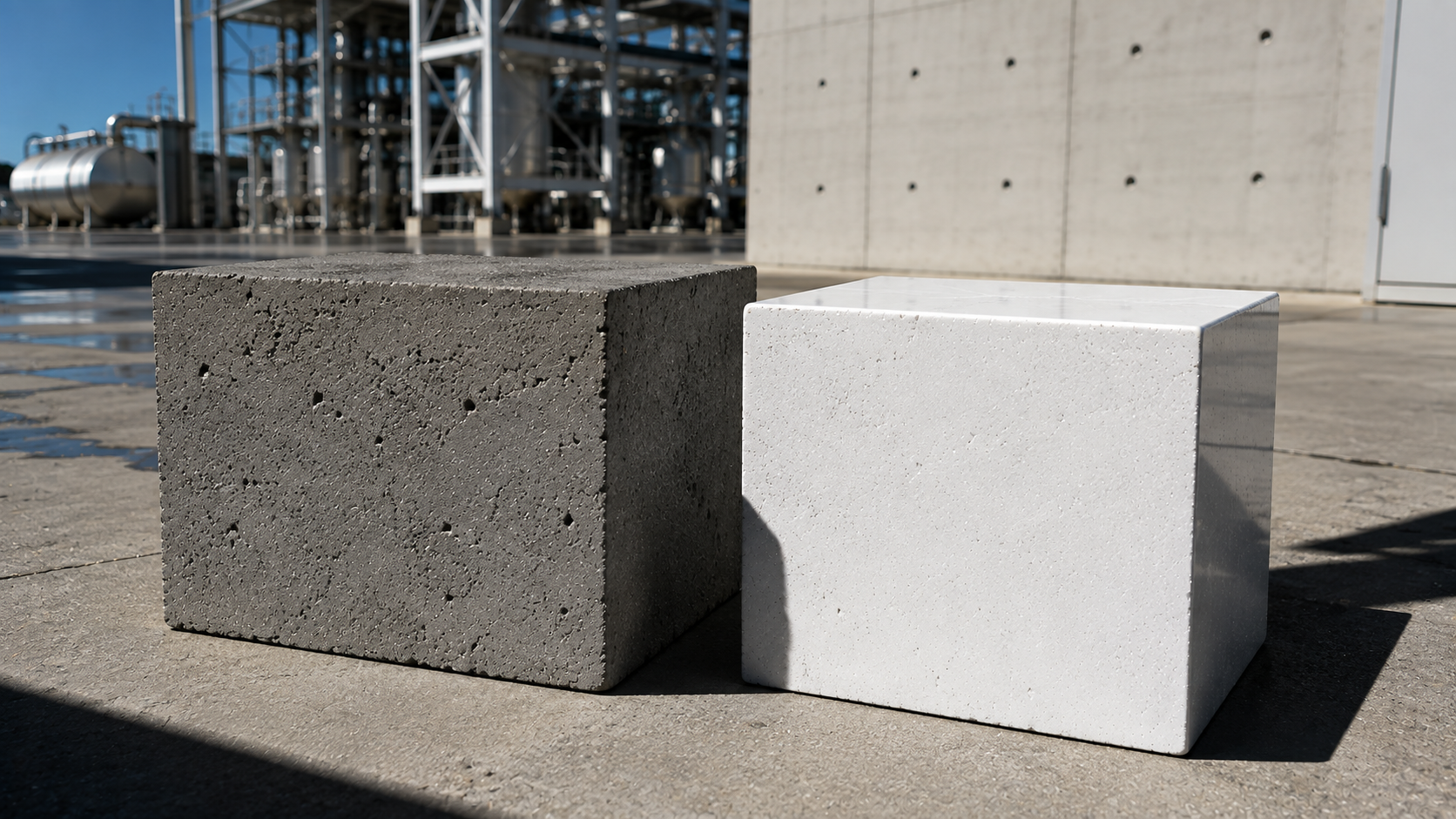
Cement test specimens incorporating this additive have already been manufactured, demonstrating its viability and ease of handling in precast plants and construction sites.
- Competitive advantages
-
- Captures CO₂ and improves passive thermal insulation in a single product.
- Operates at ambient temperature and low pressure, without aggressive additives, in under one hour.
- Mixes directly with cements and concretes, without altering manufacturing processes.
- Generates calcium carbonate and silica, useful as fillers in other industrial sectors.