
- Stage of development
-
Laboratory validation
- Intellectual property
-
Priority patent application
- Intended collaboration
-
Licensing and/or co-development
- Contact
-
Eva GabaldónVice-presidency for Innovation and Transfereva.gabaldon@csic.escomercializacion@csic.es
- Reference
-
CSIC/EG/137
Additional information
#Biotechnology
#Molecular and cell biology
#Imaging
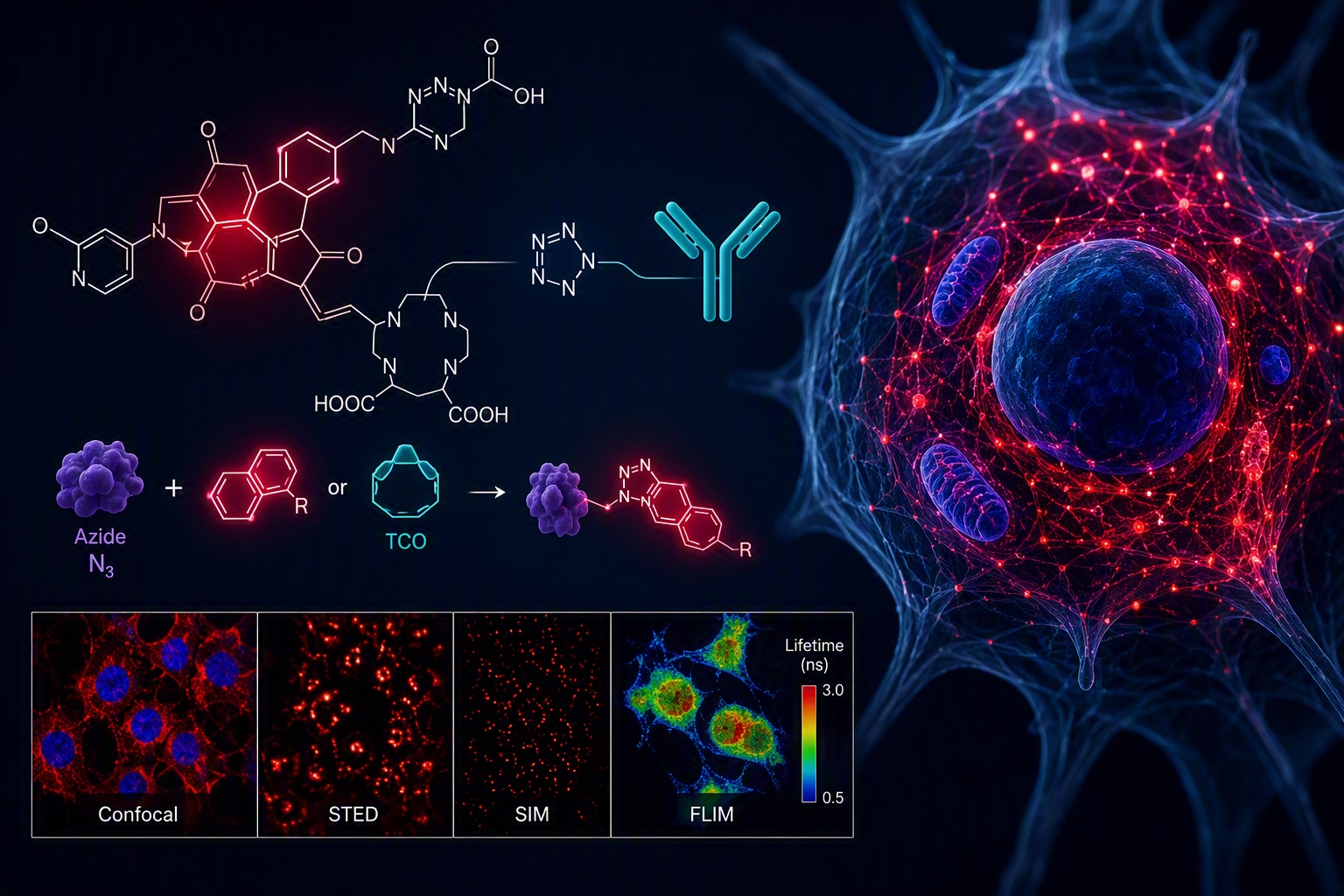
Fluorescent DAOTA probes for precision bioimaging
A novel family of DAOTA fluorescent dyes for cell and tissue bioimaging, molecular labeling, FLIM, STED, and SIM microscopy, selective biomolecule detection, click chemistry, and conjugation with proteins, biotin, and metal complexes.
- Market need
-
Advanced bioimaging applications demand brighter, highly photostable fluorescent probes that are compatible with super-resolution microscopy. There is an increasing need for red-emitting fluorophores that offer enhanced tissue penetration and reduced background autofluorescence, enabling precise visualization and monitoring of biomolecules, cells, and biological processes for biomedical research, advanced diagnostics, and therapeutic development.
- Proposed solution
-
A novel platform of DAOTA-based fluorophores with enhanced red-shifted emission, exceptional photostability, high fluorescence brightness, and long fluorescence lifetimes (≈20 ns).
These compounds deliver superior biological imaging performance through deeper tissue penetration and reduced autofluorescence background, improving the capabilities of advanced imaging techniques such as FLIM, STED, and SIM microscopy. Their versatile chemistry also enables the selective labeling and conjugation of biomolecules, proteins, and other biomedical targets, broadening their applicability in research, diagnostics, and therapeutic development.
- Competitive advantages
-
- Red-shifted emission (>625 nm), ideal for biological imaging applications.
- Low background autofluorescence, enabling higher image contrast.
- Enhanced tissue penetration for improved imaging depth.
- Outstanding performance in FLIM and super-resolution imaging techniques.
- Versatile chemistry for efficient conjugation to biomolecules and targeting agents.
- Compatibility with diverse molecular labeling and detection approaches.