
- Stage of development
-
TRL 3-4. Proof of concept validated in the laboratory across a broad range of materials
- Intellectual property
-
Priority European patent application filed
- Intended collaboration
-
Licensing and/or co-development
- Contact
-
Violeta Muñoz de la OrdenVice-presidency for Innovation and Transfervioleta.munoz@ciccartuja.escomercializacion@csic.es
- Reference
-
CSIC/MO/003
Additional information
#Materials
#Smart / Functional material
#Instrumentation
#Measurement /sensing (materials)
Photoluminescence modulation thermometry for remote temperature measurement
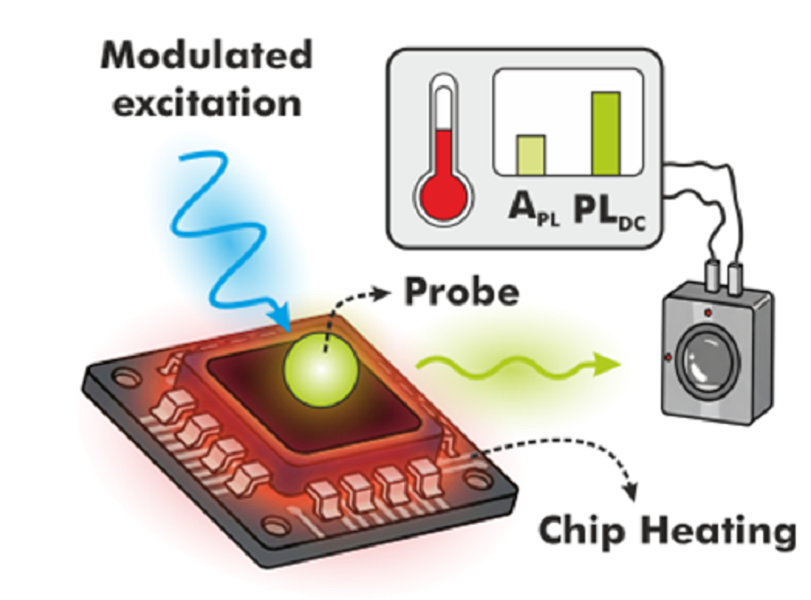
A photoluminescence-based thermometry technology enabling fast, remote, and self-referenced temperature measurements. The approach leverages temperature-dependent charge trapping dynamics, avoiding the need for complex calibration procedures and spectroscopic equipment.
- Market need
-
Current luminescence thermometry techniques face barriers that limit their industrial deployment. Many require complex instrumentation—such as pulsed excitation, time-resolved detection, or spectroscopic analysis—which increases costs and reduces robustness. In addition, most approaches rely on the absolute intensity of the luminescent signal, making them highly sensitive to misalignment, excitation-source fluctuations and environmental disturbances that affect calibration accuracy. Other solutions require highly specific materials and perform poorly under continuous illumination or in dynamic processes, limiting their scalability and adoption in real-world industrial environments.
- Proposed solution
-
A photoluminescence modulation thermometry system based on periodic optical excitation and self-referenced readout. The technology provides a fast, remote, and robust method for temperature measurement using standard LED or laser sources and simple detectors.
The system has been experimentally validated in several commercial phosphors, including aluminates and garnets, demonstrating high sensitivity and stability. Preliminary studies have shown its suitability for thermal monitoring under dynamic conditions. Additional potential applications include medicine, optoelectronics and catalysis.
- Competitive advantages
-
- Enhanced metrological reliability: eliminates errors caused by signal intensity fluctuations, misalignment and optical aging.o envejecimiento óptico.
- Non-invasive, real-time monitoring in variable environments.
- Greater material versatility than existing solutions.
- Easy industrial integration: robust and reproducible system adaptable to different industrial processes.
- Miniaturization and low-power operation potential, enhancing sustainability