
Gabriella Morreale de Castro
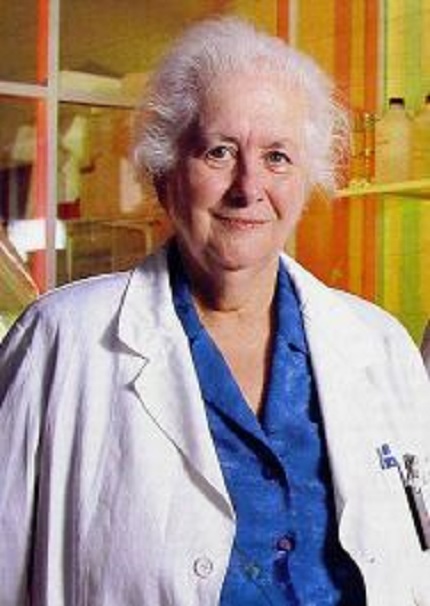
She was an Italian-Spanish chemist, CSIC research professor and a central figure in the basic and applied research of thyroid hormones of mid and end 20th century.
She did her doctoral thesis in Universidad de Granada and, after her stay in Universiteit Leiden, she joined CSIC as tenured scientist at Centro de Investigaciones Biológicas (CIB), with her husband, Francisco Escobar, in 1958. In 1962, she promoted to research scientist and in 1970 to research professor (when that category was created, she was one of the five women researchers at that time in CSIC Biomedicine. They were 8% of the total). From 1963 to 1975, she was head of Thyroid Studies Section of Instituto Gregorio Marañón. She held the Sociedad Española de Endocrinología (Spanish Endocrinology Society) between 1975 and 1979. In 1976 the group moved to the Medicine Faculty campus of the Autonomous University of Madrid and its laboratory was one of the first contributors to the training of the current Instituto de Investigaciones Biomédicas Alberto Sols, formally created in 1984. There, she continued working actively until she turned 80 years old. Gabriella always worked with “Paco” Escobar, an exemplary professional and vital tandem. She was never eclipsed by him, because they were a synergic and fruitful pair, although she was always acknowledged as an undisputed leader of group’s investigations.
She became a renowned scientist and a global authority in the knowledge of the consequences of iodine deficiency and the effect of thyroid hormones inside the brain. She decisively contributed to the implementation of “heel test” to the new-borns, as part of the congenital hyperthyroidism sub normality prevention program and to the decision of bringing and to the decision of providing iodine supplements to pregnant women to ensure the proper development of the foetus’ brain.
In 1977, she was awarded with the Premio Nacional de Investigación en Medicina (shared with F.Escobar), In 1982, she was granted the Premio Reina Sofía for research about (shared with her group and the one of Magdalena Ugarte), in 1997, the Premio Nacional of Investigación Médica Gregorio Marañón and Premio Jaime I to Medical research in 1998, among other award winners. In 2007, AMIT was appointed ad honorem associate for her recognition for an excellence international scientific career, a reference in Biomedicine, and for having created a school where other women advance.
Bibliography: Gabriella Morreale. Su vida y su tiempo, J. P. Moreno, M.J. Obregón, F. de Pablo, F. Puertas. Ediciones UAM, Madrid, 2019.ISBN:978-84-8344-701-7.
Apartado:
Mujeres Ilustres