Dorotea Barnés González
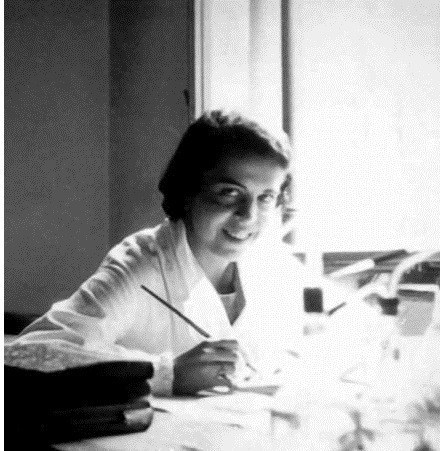
She was a Spanish chemist. Since she was a kid she had access to education, because her parents, Francisco Barnés Salinas (Public Instruction and Fine Arts minister during the Second Spanish Republic) and Dorotea González, believed in equality of opportunities and both her and her three sisters studied at the university.
In 1918, she began her studies in Universidad Complutense de Madrid and in 1931 obtained a degree in Chemical Science. Since 1928, she combined her studies with her assistance to the Sociedad Española de Física y Química headquarters and courses of Foster Laboratory of Residencia de Señoritas de Madrid, conducted by María de Maetzu.
In 1929, she obtained a scholarship for Smith College of Northampton, Massachussets, and began her research in the field of spectral analysis techniques. Gladys Anslow, doctor in Physics in Yale University and professor of Chemistry Department of Smith College, was director of her research work.
In 1930, she published some chemical and absorption spectrum of cystine, with which she obtained the Master Degree of Science awarded by Smith College. Dorotea Barnés, Mary Louise Foster and Gladys Anslow are considered the most advanced female scientists in the field of spectroscopy applied to chemical analysis.
Apartado:
Mujeres Ilustres